
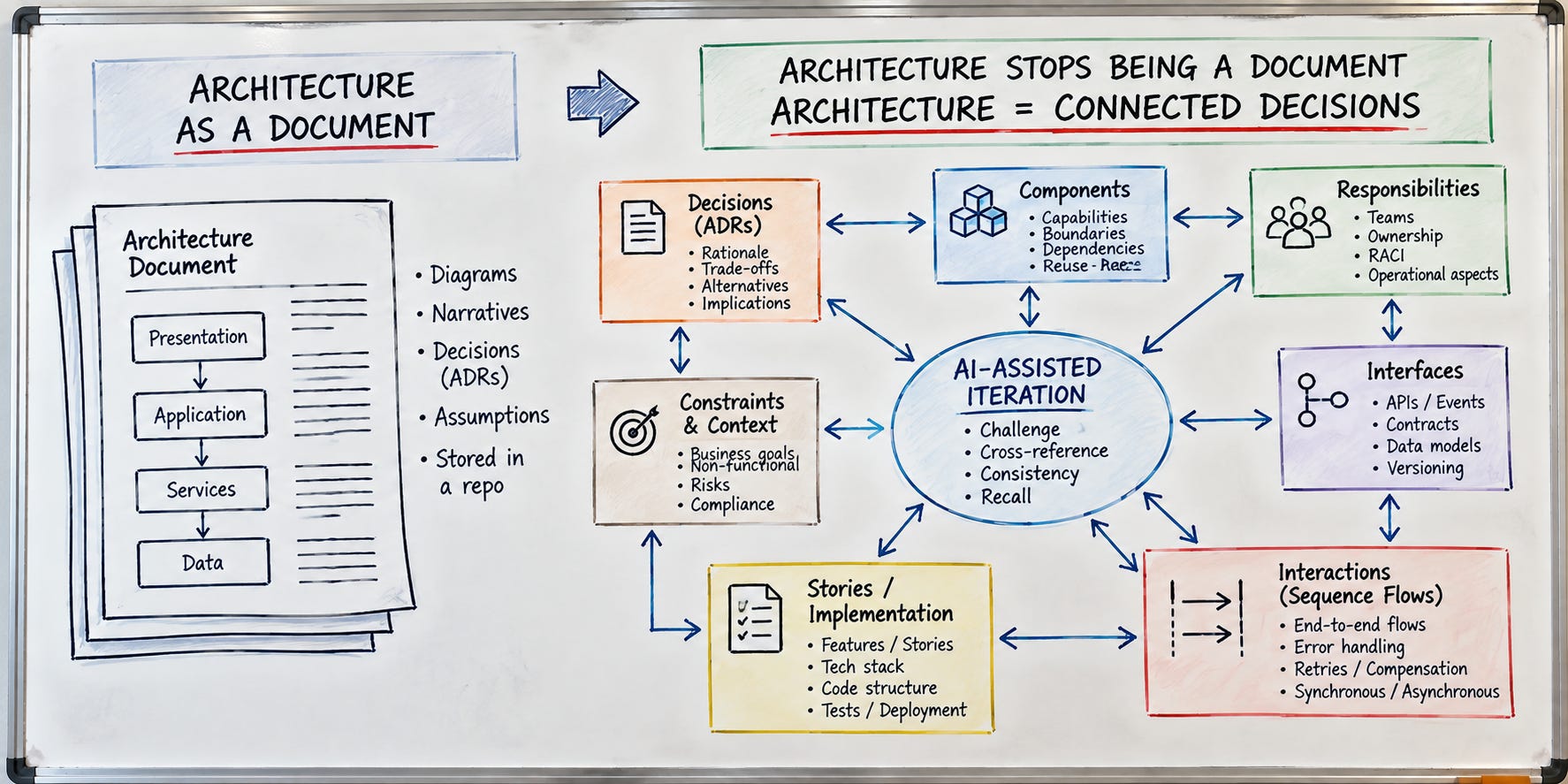
In the first article, I wrote about how working with an AI collaborator made architectural ambiguity difficult to sustain. The deeper realization came later — not about how the collaboration worked, but about what it produced. As the platform architecture evolved over four weeks, the documents themselves started changing in character. They stopped behaving like descriptive artifacts that communicated intent. They started functioning like specification systems that constrained implementation behavior downstream.
That shift was not intentional at the beginning. And that is what makes it worth writing about.
Most Architecture Documents Describe Systems. Very Few Constrain Them
Traditional architecture documents are designed to communicate intent. They explain what the system should roughly look like, how major components interact, and what principles should guide implementation. That is useful — but there is a problem.
Descriptive architecture leaves enormous room for interpretation. The gaps get filled later — during implementation, during integration, during testing, and sometimes during production incidents. Two teams can read the same architecture document and implement materially different systems while both claiming alignment to the original design. Most systems are not built directly from architecture. They are inferred from it. And inference introduces drift.
The Shift Happened Gradually
We started conventionally. Vision, principles, layers, capabilities — standard architecture work. But as we moved deeper into the platform design, the structure of the documents started changing.
Every component began using the same template: classification, purpose, responsibilities, interfaces, and guardrails. Initially, this looked like better organization. In reality, something more important was happening. The components were no longer being described. They were becoming contracts.
“Should” and “Must” Started Meaning Different Things
This became visible in the language itself. “Should” was no longer casual guidance. “Must” was no longer stylistic emphasis. The distinction became architectural.
“Must” represented non-negotiable constraints — ownership boundaries, interaction rules, workflow responsibilities, governance expectations, implementation requirements. “Should” represented strong guidance with contextual flexibility.
That level of precision mattered because the architecture was no longer sitting passively in documentation. It was feeding implementation directly.
Architecture Started Flowing Into Engineering
This is where the process fundamentally changed. The workflow evolved into something like this:
Component Specification → Jira User Stories → Claude Code → Implementation
At that point, vague architecture became operationally expensive. A vague responsibility in a component specification became a vague user story. A vague user story produced inconsistent implementation outcomes. Ambiguity amplified itself downstream. The architecture was no longer simply guiding engineering — it was shaping it.
Vague Specifications Became Impossible to Ignore
This became obvious as we moved from architecture into user story creation. A component responsibility was no longer a conceptual statement — it became one or more engineering stories, implementation contracts, acceptance criteria, and validation expectations.
An important distinction emerged here. The architecture specifies that a component must support configuration — at startup, on periodic refresh, or both. That is an architectural decision. It defines a responsibility and a behavioral expectation. But the architecture does not specify how that configuration is implemented — what gets initialized, what dependencies are validated, what configuration sources are loaded, what failures are recoverable, what state transitions occur. Those are engineering details that belong in user stories, not architecture artifacts.
The point is this: if the architecture does not clearly state that a component requires configuration support, that responsibility may never surface in a user story. It gets assumed, or worse, it gets missed entirely. This matters even more when AI assistance is not limited to code generation. In our workflow, AI generates user stories from the architecture spec itself — the component specifications, ADRs, and interaction patterns are fed as reference context. If the spec is vague, the generated stories are vague. If a responsibility is missing from the spec, the story simply does not exist. And when those stories then feed AI-assisted code generation downstream, you have two levels of amplification — vague spec produces vague stories, vague stories produce inconsistent code. The architecture is no longer just shaping what gets built. It is shaping what gets planned.
The architecture had crossed a line. It was no longer describing intent. It was defining the boundaries within which permissible behavior must be designed.
The Standards Document Changed Meaning Too
One of the clearest examples was the Development Standards document. Initially, it looked like a conventional engineering standards guide — repository structure, naming conventions, API patterns, testing expectations, database standards.
But over time, it became something else entirely. An instruction system.
Especially once AI-assisted development entered the workflow. The document eventually defined what context should be provided to coding tools, which architectural documents governed which generation tasks, generation workflows, review expectations, validation sequences, anti-patterns, and integration rules. The architecture was no longer separate from implementation. It was actively orchestrating implementation behavior.
Traceability Started Acting as Validation
The same thing happened with ADRs. Traditionally, ADRs often become historical records — useful, searchable, occasionally referenced. But in this workflow, ADR traceability became operationally necessary.
Every ADR carried context, decision, consequences, and affected components. And every mapping had to survive scrutiny. If an ADR affected a component, the relationship had to be defensible. If a component inherited a constraint, the implementation impact had to be visible.
The architecture was becoming internally cross-validating. Contradictions surfaced quickly. Missing ownership surfaced quickly. Inconsistent boundaries surfaced quickly.
Interaction Patterns Became Validation Mechanisms
This became even more visible once the interaction pattern documents matured — runtime interactions, platform interactions, cross-cutting interactions. Every sequence diagram started acting as a validation mechanism for the architecture itself.
Components had to justify their existence through actual interaction behavior. If a component never appeared in meaningful interaction patterns, the obvious question became: why does this component exist at all?
At one point, we reached a simple rule:
Components that do not participate meaningfully in system interactions should not survive the architecture.
That single realization tightened the entire platform.
The Real Shift
The important shift was not better documents, more detailed diagrams, or AI-generated specifications. It was this: the architecture became precise enough to constrain implementation behavior consistently across the system. That is a fundamentally different kind of architecture.
Because once architecture starts feeding implementation, orchestration, workflows, validation, generation, and governance — ambiguity becomes dangerous. Not in a theoretical sense. In the sense that a missing architectural responsibility — something as specific as configuration refresh support — does not get caught during story generation or code generation. It gets discovered in production, when the system cannot dynamically reload configuration without a restart. The cost of fixing that in production is orders of magnitude higher than specifying it in the architecture upfront. The entire promise of AI-assisted development is that we catch these gaps early, at the spec level, before they propagate. If the architecture is vague, we are back to the old world of discovering design gaps in production — except now we are getting there faster. And the cost is doubled. We are paying for AI-assisted tooling while still operating with the same inefficiencies that AI was supposed to eliminate. That is not transformation. That is expense without return.
Architecture Starts Behaving Like Specification
Looking back, I think this is the real transition many architecture teams are about to encounter. AI-assisted engineering will not simply accelerate coding. It will force architecture itself to become more explicit, more connected, and more internally consistent — because AI systems amplify whatever clarity or ambiguity already exists upstream. And once architecture directly influences implementation pipelines, vague thinking propagates faster than ever.
That changes the role of architecture completely. The architecture document stops being a communication artifact, a directional guide, or a static design record. It starts becoming a constraint system, a behavioral specification, and an implementation-shaping mechanism.
This also means architects can no longer sit in an ivory tower and prescribe. The era of producing high-level documents that sound architecturally elegant but never face implementation reality is over. When your architecture feeds directly into story generation and code generation, every vague responsibility, every undefined boundary, every missing constraint gets exposed — not in a review meeting months later, but immediately, in the output. Architecture artifacts have to be real. They have to survive contact with engineering. If they do not, they are not architecture. They are decoration.
I do not claim this is unique. There are architects out there who are solving this problem more effectively or more efficiently than I am — possibly in ways I have not even considered. What I do know is that this approach worked for us, the rigour held up under pressure, and the architecture is now feeding implementation in a way that feels structurally sound. That is enough to share the journey honestly and see if it resonates with others walking the same path.
This transition is only beginning. And more of us are figuring it out than we realize.
Continue to Part 3: [Architecture Emerges Through Resolved Tension]