
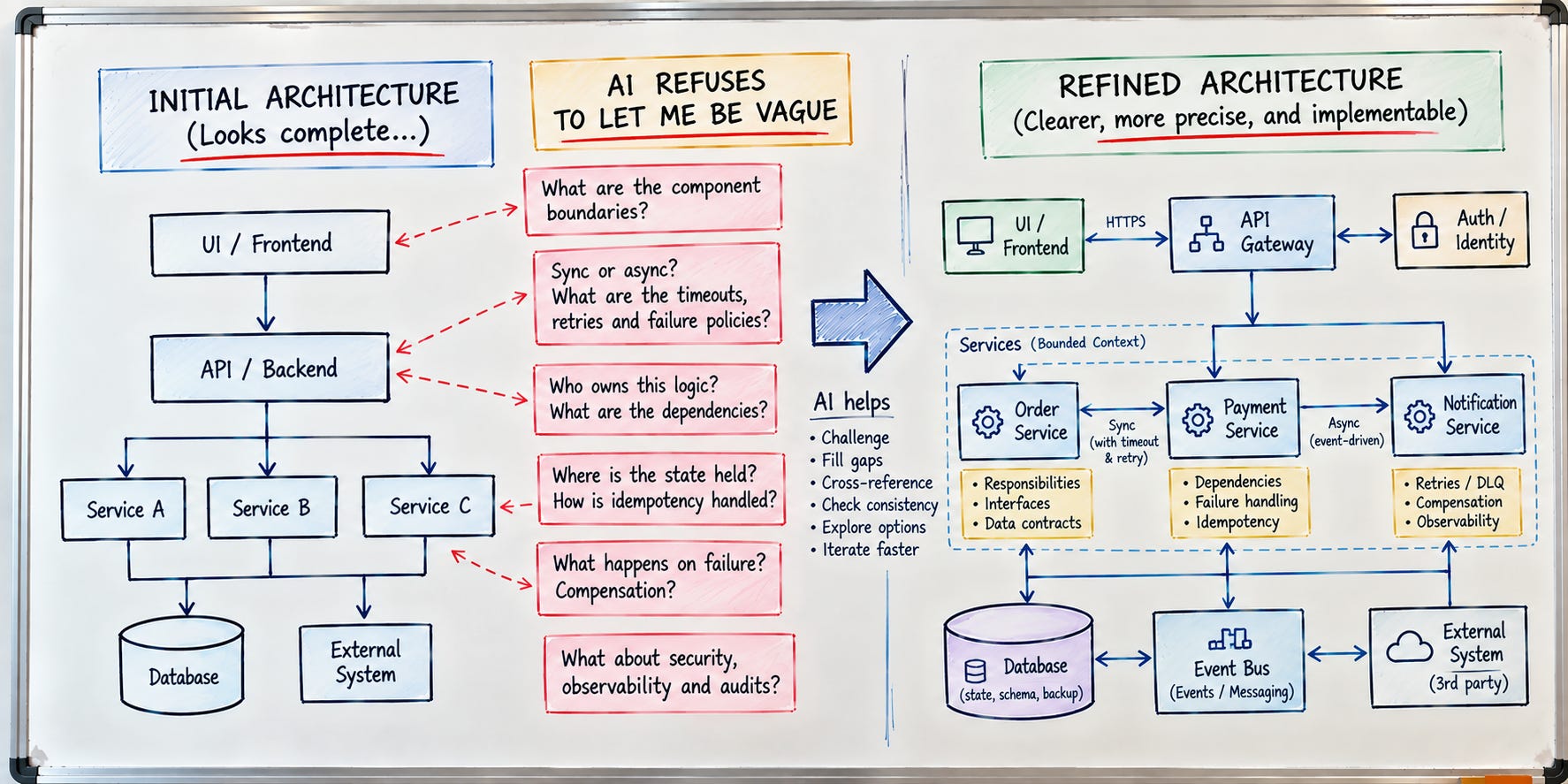
This is the first article in a three-part series on how working with AI changed the way I think about architecture — first by exposing ambiguity, then by changing architecture from documentation into specification, and finally by making me think more deeply about how architectural decisions emerge from resolved tensions.
For years, architecture has had a comfortable escape hatch. We write high-level documents, define layers, draw boxes and arrows, and talk about principles — scalability, modularity, separation of concerns. Somewhere between intent and implementation, the gaps get filled by engineers, assumptions, and occasionally luck. When things go wrong, we call it “execution issues.”
But the truth is simpler. Most architecture is underspecified. And we rarely question it — until something breaks.
The Illusion of Clarity
Ask ten engineers to implement the same architecture document and you will not get one system. You will get ten interpretations. The reason is straightforward: most architecture is written as narrative, not specification.
In practice, this means components are named but not defined. Boundaries are implied but not enforced. Interactions are described but not modeled. Decisions are taken but rarely made explicit with context and rationale.
The irony is that the tools to do this properly have existed for decades. UML gave us sequence diagrams, class diagrams, data models, responsibility assignments — a complete vocabulary for defining architecture at a level of precision that could flow directly into implementation. The discipline was always available. Most architects just never followed through to that level. They stopped at block diagrams — boxes with labels, arrows with vague annotations — and called it architecture. Sequence diagrams were skipped. Data models were left to DBAs. Class responsibilities were left to developers. The core object-oriented principles that UML was designed to express rarely made it into architecture artifacts at all.
For years, this has been acceptable. Even normal. The architect defines the high-level vision from the ivory tower — layers, principles, component names, interaction narratives — and leaves it to the engineering teams to figure out what actually needs to be built. The real architecture happens during implementation, not before it. That worked — until it did not.
Then I Changed How I Worked
I recently spent a month designing an enterprise AI platform — not with a team of architects, but with an AI collaborator. Not to generate documents, but to work through the architecture decision by decision, component by component, interaction by interaction.
What changed was not who was doing the architecture. It was how rigorously every decision had to stand up to scrutiny.
This was not “generate me an architecture.” That path produces output that looks convincing and fails quietly. The dynamic was closer to this: I set direction based on experience, constraints, and what I have seen fail in production. The AI responded with structured options grounded in industry patterns. I challenged, rejected, refined. It pushed back when something did not hold. We iterated until the decision was tight.
Every decision had to survive a challenge. Not because the AI “knew better,” but because it forced the conversation to be explicit. You cannot hand-wave a component responsibility when your collaborator immediately asks how that responsibility manifests in interaction patterns across the system.
Where AI Actually Helped
Not in the way most people expect. The value was not intelligence. It showed up in very specific, operational ways.
Perfect recall across sessions — every decision, every assumption, every constraint we had discussed in week one was still present and enforced in week four. Relentless consistency checks — contradictions between components, between patterns, between ADRs did not survive. They were caught as they happened, not weeks later in a review cycle. Speed of iteration — an idea could be explored, challenged, refined, and either adopted or discarded in minutes rather than days.
But these only matter if the architect is driving. If the input is shallow, the output is polished but equally shallow. If the direction is unclear, the system converges to something generic. AI does not fix weak architecture. It accelerates it.
What Changed for Me as an Architect
The biggest shift was not productivity. It was accountability.
I could not get away with ambiguity anymore. Propose a component without a clear responsibility — it had to be justified or it did not survive. Introduce a boundary — it had to be enforced in interaction patterns, not just drawn on a diagram. Make a decision — it had to hold across patterns, components, and implementation stories. Not because the AI demanded it, but because gaps became visible immediately. And once visible, you either resolve them or you carry them knowingly. There is no third option.
This is a fundamentally different way of working. In a traditional architecture process, ambiguity hides comfortably in high-level documents. It surfaces months later when engineers hit the gap during implementation. With an AI collaborator holding the full context and cross-referencing every decision in real-time, that hiding place disappears.
Architecture Stops Being a Document
When you work this way, something important changes. You are no longer writing architecture as a description of what the system should look like. You are shaping a coherent system of decisions where each one is connected to and validated against the others. Components are defined by responsibilities and interfaces. Interactions are validated through sequence diagrams and pattern documents. Decisions are recorded with context, rationale, and traceability to the components they govern. Implementation stops being a separate phase — it is already implied in the specification.
If this sounds familiar, it should. This is what UML was always designed to produce. Most architects abandoned that level of rigour because the effort of maintaining it manually across a living system was brutal — not just the upfront cost of producing it, but the ongoing cost of keeping it current as the system evolved. With AI in the loop, both costs collapse. Updates that used to take days of cross-referencing happen in minutes. The architecture stays current because the cost of keeping it current is no longer prohibitive. And as I will explore in the next article, that cost is worth paying — because when architecture feeds directly into story generation and code generation, keeping it precise and current is no longer optional.
The gap between “what was designed” and “what gets built” starts shrinking. Every new component inherits the rigour of the ones before it. Every new interaction pattern validates or exposes gaps in earlier decisions. The architecture becomes internally self-reinforcing.
The Uncomfortable Truth
This is where most architects will disagree — not because it is wrong, but because it is uncomfortable.
AI does not make you a better architect. It does something more revealing. It exposes the quality of your thinking, continuously. Weak reasoning becomes obvious because the AI will build on it faithfully and the cracks will show in the downstream artifacts. Conflicts surface immediately because the system of decisions is cross-referenced in real-time. Abstraction collapses into specifics because every high-level statement eventually has to manifest in a component, an interaction, or a story.
There is no place to hide behind abstraction anymore. And that is either terrifying or liberating, depending on the quality of what you bring.
What Actually Gets Supercharged
The role of the architect becomes clearer and more visible when AI enters the workflow. AI removes friction around iteration, cross-referencing, tracking decisions, and exploring alternatives. What remains — and what gets amplified — is judgment, experience, clarity of thought, and the ability to define boundaries and trade-offs.
The outcome is as strong or as weak as the architect behind it. That has always been true. The difference now is that it becomes visible much faster.
The Bottom Line
AI did not design my architecture. It refused to let me be vague.
It made ambiguity difficult to sustain. The architecture that emerged is not a product of automation. It is the result of deliberate decisions, continuous challenge, and disciplined iteration. AI made that process faster and more consistent. But the quality came from the thinking.
And that has always been the real job of the architect.
Continue to Part 2: [Architecture Stops Being Documentation]